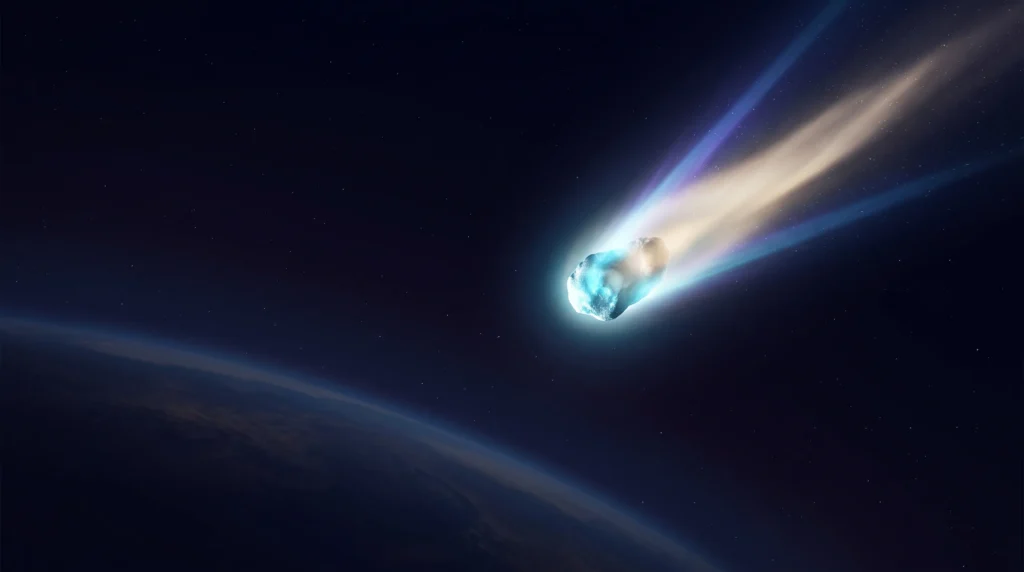

A comet is a small celestial body made primarily of ice, dust, and rocky material that travels around the Sun. As it approaches the Sun, its surface releases gas and dust, often creating a glowing coma and a distinctive tail.
If you are looking for synonyms for comet, the closest alternatives depend on how precisely you want to describe it. Terms such as celestial body, heavenly body, and astronomical object are broader descriptions, while dirty snowball is an informal expression associated with the composition of a comet.
However, not every space-related word is a true synonym. An asteroid, meteor, and shooting star are associated with similar astronomical subjects, but each describes something different.
This guide explores useful alternatives, explains their differences, and provides examples to help you choose the right word.
What Are the Best Synonyms for Comet?
Here are some useful synonyms and alternative expressions for comet, arranged according to their accuracy and context.
Closest descriptive alternatives
- Celestial body
- Heavenly body
- Astronomical object
- Solar system object
- Small Solar System body
- Icy body
- Icy celestial object
- Dirty snowball
Broader and context-dependent alternatives
- Space object
- Cosmic object
- Celestial object
- Transient celestial object
- Interplanetary object
- Astronomical body
- Solar orbiter
Important distinction: None of these expressions is a perfect replacement for comet in every situation. The most scientifically appropriate alternatives are descriptive terms such as icy celestial body and Small Solar System body. Other expressions refer to broader astronomical categories rather than comets specifically.
ALSO CHECKOUT: Synonyms of Cryptic: 25 Words and Their Meanings
What Does Comet Mean?
A comet is a small icy object that orbits the Sun. It consists of frozen gases, dust, and rocky material left over from the formation of the Solar System.
When a comet approaches the Sun, solar heating causes some of its frozen material to turn directly into gas. This process, called sublimation, releases gas and dust around the nucleus.
Consequently, a glowing cloud called a coma can form around the nucleus. A tail may also develop, extending away from the Sun under the influence of sunlight and the solar wind.
Example: A bright comet appeared in the night sky, attracting the attention of astronomers and stargazers.
What are the main parts of a comet?
Rocks in Solar System: Asteroids, Comets and Meteoroids – HubPages
A comet typically has several identifiable features:
- Nucleus: The solid central part made of ice, dust, and rocky material.
- Coma: The cloud of gas and dust surrounding the nucleus.
- Dust tail: A tail of dust particles that generally curves along the comet’s orbital path.
- Ion tail: A tail of electrically charged gas that generally points away from the Sun.
These features help distinguish a comet from other astronomical objects.
READ ALSO: Synonyms for Comet: Meaning, Related Words, and Examples — Draft
15 Synonyms and Alternative Expressions for Comet Explained
The following expressions can help describe comets in scientific writing, educational material, creative descriptions, and everyday conversation.
Nevertheless, it is important to distinguish direct alternatives from broader category names.
1. Celestial Body
A celestial body is a natural object that exists in space, such as a planet, star, moon, asteroid, or comet.
This is one of the most useful general alternatives when discussing comets in an astronomical context.
However, it is not exclusive to comets because many other objects qualify as celestial bodies.
Example: The astronomers observed a celestial body travelling through the outer Solar System.
Best context: Astronomy, educational writing, and general descriptions of objects in space.
Synonym type: Broad descriptive alternative.
2. Heavenly Body
A heavenly body is another expression for a natural object found in space.
It has essentially the same broad meaning as celestial body, although it can sound more traditional, literary, or poetic.
For instance, writers may use this expression when describing the beauty of the night sky.
Example: The ancient observers carefully recorded the movements of heavenly bodies.
Best context: Literature, general astronomy, and descriptive writing.
Synonym type: Broad descriptive alternative.
3. Astronomical Object
An astronomical object refers to an identifiable natural object or structure studied in astronomy.
Comets fall into this category, alongside stars, planets, moons, asteroids, and galaxies.
Moreover, the expression sounds suitable for scientific and educational discussions.
Example: Researchers identified an unusual astronomical object approaching the inner Solar System.
Best context: Scientific articles, research, and astronomy education.
Synonym type: Broad descriptive alternative.
4. Solar System Object
A Solar System object is an object that belongs to or is associated with our Solar System.
Comets, planets, dwarf planets, moons, and asteroids are examples.
This expression is useful when discussing the location and orbital behaviour of a comet.
Example: The newly discovered Solar System object follows an elongated orbit around the Sun.
Best context: Astronomy, planetary science, and scientific descriptions.
Synonym type: Broad category term.
5. Small Solar System Body
A Small Solar System body is a recognised astronomical classification for smaller natural objects orbiting the Sun that are not classified as planets or dwarf planets, or as satellites.
Comets are included in this broader category.
Unlike a casual expression such as space object, this term has a more specific scientific meaning.
Example: The spacecraft collected valuable information about the small Solar System body.
Best context: Scientific writing, astronomy education, and planetary research.
Synonym type: Scientific category term.
6. Icy Body
An icy body is an astronomical object containing substantial quantities of frozen material.
Comets are commonly described this way because their nuclei contain water ice and other frozen substances.
However, the expression can also describe other objects, including icy moons and distant bodies in the outer Solar System.
Example: The icy body released gas and dust as it moved closer to the Sun.
Best context: Planetary science and descriptions of comet composition.
Synonym type: Descriptive alternative.
7. Icy Celestial Object
An icy celestial object is a descriptive expression for a natural object in space containing significant frozen material.
It can be useful when the writer wants to emphasise the icy composition of a comet without using technical terminology.
Nevertheless, it is not a specific astronomical classification.
Example: The icy celestial object developed a visible coma as solar radiation warmed its surface.
Best context: Educational explanations and accessible scientific writing.
Synonym type: Descriptive alternative.
8. Dirty Snowball
A dirty snowball is an informal expression historically used to describe a comet’s nucleus.
The phrase refers to the mixture of ice, dust, and rocky material that makes up a comet.
It creates an understandable mental picture, although modern scientific descriptions of comet composition are more complex.
Example: The teacher described the comet as a dirty snowball travelling around the Sun.
Best context: Informal astronomy explanations and educational discussions.
Synonym type: Informal descriptive expression.
9. Space Object
A space object is a broad expression for something that exists in outer space.
A comet qualifies as a space object, but the term can also describe planets, satellites, asteroids, and artificial spacecraft.
Therefore, it is useful for general descriptions but lacks the precision of the word comet.
Example: The telescope detected a moving space object near the edge of its observation field.
Best context: Everyday conversation and introductory astronomy.
Synonym type: Broad alternative.
10. Cosmic Object
A cosmic object refers broadly to an object or entity found in the universe.
It is often used in descriptive or popular science writing rather than as a precise astronomical classification.
Example: The unusual cosmic object attracted attention because of its bright appearance.
Best context: Popular science, creative writing, and general descriptions of space.
Synonym type: Broad descriptive alternative.
11. Celestial Object
A celestial object describes a natural object located in space.
It is closely related to celestial body and can refer to a comet, planet, star, or other astronomical object.
Example: The celestial object became brighter as it approached the Sun.
Best context: Astronomy education and general scientific writing.
Synonym type: Broad descriptive alternative.
12. Transient Celestial Object
A transient celestial object is a descriptive expression for an astronomical object or phenomenon that appears or changes noticeably over a relatively short observational period.
The term is not a standard synonym for comet. However, it may be suitable in a discussion about a comet’s temporary visibility or changing appearance.
Example: The bright comet became a prominent transient feature in the evening sky.
Best context: Observational astronomy and descriptive writing.
Synonym type: Context-dependent expression.
13. Interplanetary Object
An interplanetary object is a descriptive term for an object travelling through the space between planets.
A comet can be described as an interplanetary object when discussing its movement through the Solar System.
However, the expression is not limited to comets.
Example: The spacecraft monitored the interplanetary object during its journey through the inner Solar System.
Best context: Space exploration and discussions of objects travelling through the Solar System.
Synonym type: Context-dependent alternative.
14. Astronomical Body
An astronomical body is a general expression for a natural physical object in space.
It can describe planets, moons, asteroids, and comets.
Although it is understandable, celestial body is often the more familiar expression in general English.
Example: The astronomical body displayed a long, luminous tail during its closest approach to the Sun.
Best context: General scientific and educational descriptions.
Synonym type: Broad descriptive alternative.
15. Solar Orbiter
A solar orbiter is not a scientifically accurate synonym for a comet. It may be used descriptively to refer to an object orbiting the Sun, but it can also be confused with spacecraft designed to study the Sun.
For that reason, it is better to use solar-orbiting object when describing a comet’s orbital movement.
Example: The solar-orbiting object followed an elongated path around the Sun.
Best context: Descriptive discussions of orbital movement.
Synonym type: Context-dependent description, not a direct synonym.
Best Words to Use Instead of Comet in Different Contexts
The right alternative depends on what you want to emphasise. Some expressions highlight a comet’s composition, while others describe its astronomical classification or appearance.
| Context | Recommended alternative | Why it works |
|---|---|---|
| Scientific writing | Small Solar System body | Provides a recognised broad classification |
| General astronomy | Celestial body | Clear and widely understood |
| Educational explanations | Icy body | Highlights its composition |
| Informal descriptions | Dirty snowball | Explains its icy and dusty structure |
| Literary writing | Heavenly body | Creates a poetic tone |
| Technical discussions | Astronomical object | Sounds neutral and scientific |
| Orbital descriptions | Solar System object | Emphasises its place in the Solar System |
Comet synonyms for scientific writing
When writing about astronomy, scientific accuracy should come before stylistic variation.
The expressions celestial body, astronomical object, and Small Solar System body are useful, depending on the intended level of specificity.
For example:
- Original: The comet entered the inner Solar System.
- Alternative: The icy body entered the inner Solar System.
The alternative emphasises the object’s physical composition.
Comet synonyms for creative writing
In poetry, storytelling, and descriptive writing, broader expressions can help create variety.
Consider these alternatives:
- Heavenly visitor
- Celestial wanderer
- Icy wanderer
- Cosmic traveller
These are creative descriptions rather than established scientific synonyms.
Example: A brilliant celestial wanderer crossed the dark evening sky.
Such expressions can make creative writing more engaging, although the original word comet is preferable when scientific precision matters.
Comet synonyms for everyday conversation
For casual explanations, simple descriptions are generally more effective.
Consider:
- Space object
- Celestial body
- Icy object
- Dirty snowball
Example: We watched an icy object with a glowing tail moving across the night sky.
Although the description is understandable, calling it a comet is more precise if its identity is known.
Comet vs Asteroid vs Meteor vs Shooting Star
Comet is sometimes confused with other astronomical terms because these objects are all associated with space.
However, they describe different things.
Cuándo el cometa 3I/Atlas tendrá su máxima aproximación a la Tierra | EL COMERCIO PERÚ
meteor: A look at five biggest meteor crashes of all time – The Economic Times
| Word | Meaning | Main distinction |
|---|---|---|
| Comet | An icy body orbiting the Sun | Can develop a coma and tail |
| Asteroid | A relatively small rocky or metallic body orbiting the Sun | Generally lacks a comet-like coma and tail |
| Meteor | The visible phenomenon caused by a meteoroid entering an atmosphere | Appears as a streak of light |
| Shooting star | An everyday expression for a meteor | Describes the visible streak, not an actual star |
| Meteoroid | A small natural rocky or metallic object travelling through space | Can produce a meteor when entering an atmosphere |
Is an asteroid a synonym for comet?
No. Although both orbit the Sun, asteroids and comets have different physical characteristics and typical compositions.
Asteroids are generally rocky or metallic, whereas comets contain substantial quantities of ice and can develop visible comae and tails.
Is a shooting star another name for a comet?
No. A shooting star is a common expression for a meteor, which is a streak of light produced when material enters an atmosphere.
A comet, by contrast, is an object travelling around the Sun.
Therefore, using shooting star as a synonym for comet would be scientifically incorrect.
Related Vocabulary Associated With Comets
Understanding related astronomical terms can make descriptions of comets more accurate.
Here are several useful words:
| Word | Meaning |
|---|---|
| Nucleus | The solid central part of a comet |
| Coma | The cloud of gas and dust surrounding its nucleus |
| Tail | Material extending away from the comet’s nucleus and coma |
| Sublimation | The process in which a solid changes directly into gas |
| Orbit | The curved path followed by an object around another object |
| Perihelion | The point in an orbit where an object is closest to the Sun |
| Aphelion | The point in an orbit where an object is farthest from the Sun |
| Volatiles | Substances that readily vaporise under suitable conditions |
| Interstellar | Originating from or existing between stars |
These terms are particularly useful in scientific explanations because they describe different characteristics and behaviours of comets.
Frequently Asked Questions About Synonyms for Comet
1. What is the closest synonym for comet?
There is no exact one-word synonym that works in every context. Icy celestial body is a useful descriptive alternative, while celestial body and astronomical object are broader terms.
2. What is another name for a comet?
A comet is sometimes informally called a dirty snowball because its nucleus contains ice, dust, and rocky material. However, this expression is descriptive rather than a formal scientific name.
3. What is a poetic word for comet?
Expressions such as celestial wanderer, heavenly visitor, cosmic traveller, and icy wanderer can be used poetically.
They describe a comet’s appearance and movement rather than providing formal astronomical classifications.
4. Is celestial body a synonym for comet?
Celestial body is a broader descriptive term that includes comets, planets, stars, moons, and other natural objects in space.
Therefore, it can describe a comet, but it does not identify one specifically.
5. Is asteroid another word for comet?
No. Asteroids and comets are different types of Solar System objects. Asteroids are generally rocky or metallic, while comets contain substantial amounts of ice and can develop a coma and tail.
6. What is the opposite of comet?
There is no established antonym for comet because it is the name of a specific type of astronomical object rather than a quality or action with a natural opposite.
7. What is the scientific term for a comet?
A comet is itself the scientific term. It is classified as a small Solar System body, and its nucleus typically consists of ice, dust, and rocky material.
8. Can cosmic object replace comet?
Sometimes, but cosmic object is much broader. It can describe almost any object in space, so it does not communicate the distinctive characteristics of a comet.
Conclusion
Finding synonyms for comet requires understanding the difference between a specific astronomical object and the broader terms used to describe things in space.
The most useful alternatives include celestial body, heavenly body, astronomical object, icy body, and Small Solar System body. Meanwhile, dirty snowball offers an informal description of a comet’s composition, and expressions such as celestial wanderer can add creativity to descriptive writing.
Nevertheless, these alternatives are not all exact synonyms. For scientific accuracy, use comet whenever you are referring specifically to that type of icy Solar System object. Choose broader expressions when you want to describe its nature, composition, or place in the universe.