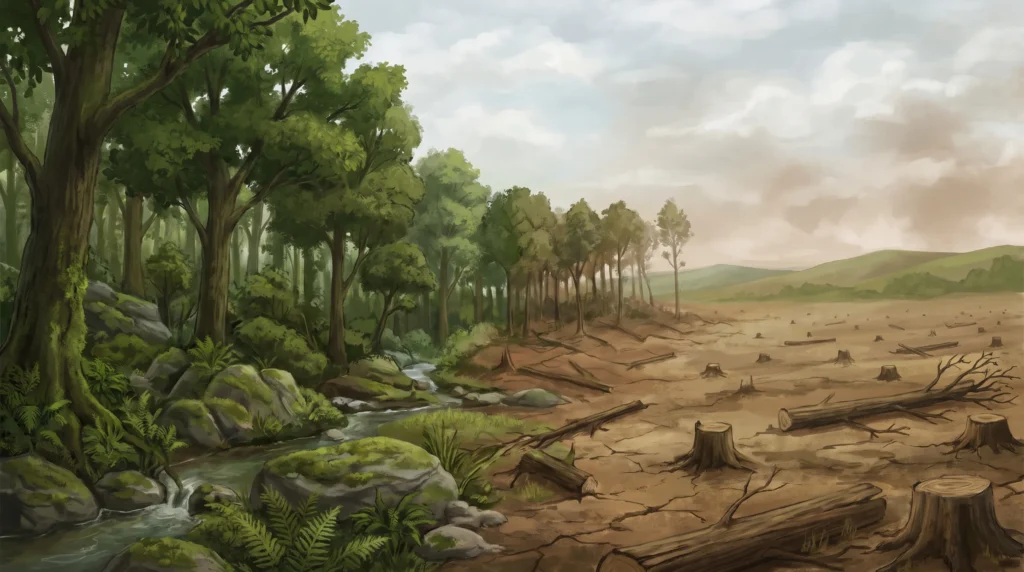

Deforestation refers to the large-scale removal of trees and the conversion of forested land into areas used for agriculture, construction, mining, or other purposes. However, not every expression describing tree removal carries exactly the same meaning.
If you are looking for synonyms of deforestation, some of the most useful alternatives include forest clearing, forest removal, forest destruction, tree removal, woodland clearance, and forest degradation. Other related terms, such as logging, land clearing, and habitat destruction, describe particular activities or consequences rather than the entire meaning of deforestation.
Choosing the right alternative depends on what you want to emphasize: the removal of trees, the destruction of a forest ecosystem, the commercial harvesting of timber, or the conversion of forestland.
This guide explains the most useful alternatives, their differences, and how to use them naturally in sentences.
What Are the Best Synonyms of Deforestation?
The following are some of the closest synonyms and context-dependent alternatives for deforestation:
| Synonym or alternative | Meaning |
|---|---|
| Forest clearing | Removing trees from a forested area |
| Forest removal | Eliminating forest cover from an area |
| Forest destruction | Damaging or destroying forest ecosystems |
| Tree removal | Taking trees away from a particular area |
| Woodland clearance | Clearing trees and vegetation from woodland |
| Forest clearance | Removing forest vegetation, often to make land available for another use |
| Forest conversion | Changing forestland into another type of land use |
| Land clearing | Removing trees and vegetation to prepare land for another purpose |
| Woodland removal | Removing wooded areas or their tree cover |
| Logging | Cutting trees for timber or commercial purposes |
| Clear-cutting | Removing nearly all trees from a designated forest area |
| Forest degradation | Reducing the quality, health, or ecological condition of a forest |
| Habitat destruction | Damaging or eliminating the natural habitats of wildlife |
| Tree felling | Cutting down standing trees |
| Forest depletion | Reducing forest resources or forest cover over time |
Best overall alternatives: Forest clearing, forest clearance, and forest removal are among the closest substitutes when referring to the removal of forest cover.
Best alternatives for environmental writing: Forest destruction, forest degradation, and habitat destruction are useful when emphasizing ecological damage.
Best alternatives for commercial activities: Logging, tree felling, and clear-cutting are appropriate when discussing particular methods of cutting or harvesting trees.
Not all these expressions are interchangeable. Their differences become important in formal writing, environmental discussions, and everyday communication.
What Does Deforestation Mean?
Deforestation is a noun that describes the large-scale removal or loss of forest cover, usually when forestland is permanently or substantially converted to another land use.
It commonly occurs when forests are cleared for:
- Agricultural fields and livestock grazing.
- Roads, buildings, and urban development.
- Mining and industrial activities.
- Commercial timber production.
- Infrastructure and settlement expansion.
Deforestation can have serious environmental consequences, including habitat loss, reduced biodiversity, soil erosion, and changes in the carbon cycle.
Example sentence:
Deforestation has reduced the natural forest cover in several regions, threatening wildlife and disrupting local ecosystems.
The word is generally associated with environmental damage, although the precise causes and consequences depend on the circumstances.
Understanding the Word
The word deforestation is formed from the prefix de-, suggesting removal or reversal, and forest.
Its meaning focuses on the loss of forest cover rather than simply the act of cutting an individual tree.
For example:
- Cutting down one tree in a garden is tree removal, not necessarily deforestation.
- Harvesting selected trees in a managed forest is not automatically deforestation.
- Clearing a large forest area to establish agricultural land is a typical example of deforestation.
This distinction is essential when selecting an appropriate synonym.
15 Synonyms and Related Alternatives for Deforestation Explained
Here are the most useful alternatives, with their meanings, differences, and examples.
1. Forest Clearing
Forest clearing is one of the closest and most natural alternatives to deforestation.
It refers to removing trees and other vegetation from a forested area, often to prepare the land for farming, construction, or another purpose.
Unlike deforestation, which emphasizes the loss of forest cover as a broader process, forest clearing emphasizes the physical activity of removing vegetation.
Example: Forest clearing for agricultural expansion has transformed large areas of natural woodland.
Best used when: Describing the physical removal of forest vegetation or the preparation of land for another use.
Very close alternative
2. Forest Clearance
Forest clearance describes the removal of trees and vegetation from forestland.
It is particularly suitable for environmental reports, land-use discussions, and formal writing.
The expression is especially familiar in British English, where clearance is a common spelling and usage.
Example: Forest clearance near the river has increased the risk of soil erosion.
Difference: Forest clearance emphasizes the act or process of clearing, while deforestation often refers to the broader loss of forest cover.
Best used when: Discussing land preparation, development projects, or environmental changes.
3. Forest Removal
Forest removal means eliminating forest cover from a particular area.
It is a relatively neutral expression that focuses on the disappearance of trees rather than the reason behind their removal.
Example: Forest removal for new infrastructure projects has altered the landscape.
Difference: Forest removal is descriptive and straightforward, whereas deforestation is the established technical term for the broader process of forest loss and conversion.
Best used when: You want a neutral alternative in reports, explanations, and environmental discussions.
4. Forest Destruction
Forest destruction refers to the severe damage or elimination of forests and their ecological systems.
It has a stronger negative connotation than deforestation.
While deforestation describes the loss of forest cover, forest destruction emphasizes the harmful consequences for vegetation, wildlife, and ecosystems.
Example: Illegal activities have contributed to widespread forest destruction in the region.
Difference: Forest destruction can include severe ecological damage even when some tree cover remains.
Best used when: Emphasizing environmental harm, ecological damage, or the seriousness of forest loss.
5. Tree Removal
Tree removal means taking trees out of a particular location.
It is broader and less specific than deforestation because it can refer to individual trees, urban vegetation, orchards, or entire wooded areas.
Example: Tree removal along the proposed highway route will affect several local habitats.
Difference: Removing trees does not necessarily mean that a forest is being permanently converted to another land use.
Best used when: Discussing the removal of trees without necessarily referring to large-scale forest loss.
6. Woodland Clearance
Woodland clearance refers to removing trees and vegetation from woodland.
It is a useful alternative in discussions about land management, construction, agriculture, and environmental change.
Example: Woodland clearance for housing development has reduced the area’s natural vegetation.
Difference: Woodland generally refers to land covered with trees but may have a different ecological structure from a dense forest.
Best used when: Discussing the removal of wooded land, particularly in British English contexts.
7. Forest Conversion
Forest conversion describes changing forestland into another type of land use.
For example, a forest may be converted into farmland, pasture, a residential development, or an industrial site.
Example: Forest conversion for commercial agriculture has contributed to the decline of natural habitats.
Difference: This expression emphasizes the change in land use rather than the physical act of cutting trees.
Best used when: Discussing agricultural expansion, urban development, land-use changes, and environmental research.
8. Land Clearing
Land clearing means removing trees, vegetation, shrubs, or other natural features from an area to prepare it for a particular purpose.
It is broader than deforestation because it also applies to grasslands, scrubland, and other types of land.
Example: Land clearing for new agricultural fields has affected nearby forest ecosystems.
Difference: Land clearing does not necessarily involve forests.
Best used when: Discussing construction, agriculture, infrastructure, and general land preparation.
9. Woodland Removal
Woodland removal refers to eliminating wooded areas or removing their tree cover.
It is a relatively descriptive expression that can be useful when the subject is specifically woodland rather than forests in general.
Example: Woodland removal has reduced the availability of shelter for native wildlife.
Difference: It is less established as a technical term than deforestation and may sound more descriptive than scientific.
Best used when: Discussing the disappearance of wooded landscapes.
10. Logging
Logging refers to cutting down and extracting trees, particularly for timber and other commercial uses.
It is closely associated with forest exploitation, but it is not an exact synonym for deforestation.
Logging can take place in sustainably managed forests without necessarily causing permanent forest loss.
Example: Unsustainable logging has damaged large sections of the natural forest.
Difference: Logging describes an activity, while deforestation describes the loss or conversion of forest cover.
Best used when: Discussing timber production, commercial forestry, and tree harvesting.
11. Clear-Cutting
Clear-cutting is a forestry practice in which nearly all trees within a designated area are harvested or removed.
It can contribute to deforestation, particularly when the cleared land is not allowed to regenerate or is converted to another use.
Example: Clear-cutting on the hillside has dramatically changed the appearance of the landscape.
Difference: Clear-cutting is a specific method of harvesting trees, not another name for every form of deforestation.
Best used when: Describing intensive timber harvesting or the complete removal of trees from a particular section of forest.
12. Forest Degradation
Forest degradation refers to a decline in the quality, ecological health, or functioning of a forest.
A degraded forest may still contain trees, but it may have reduced biodiversity, damaged vegetation, weakened ecological processes, or diminished carbon-storage capacity.
Example: Illegal timber harvesting and repeated fires have contributed to forest degradation.
Difference: Deforestation involves the loss of forest cover, whereas degradation involves a decline in forest condition. The two processes can occur together but are not identical.
Best used when: Discussing environmental damage that does not necessarily involve complete forest removal.
13. Habitat Destruction
Habitat destruction means damaging or eliminating the natural environments in which plants and animals live.
Deforestation is one important cause of habitat destruction, but habitat destruction can also occur in oceans, grasslands, wetlands, and other ecosystems.
Example: Deforestation has caused widespread habitat destruction, threatening several endangered species.
Difference: Habitat destruction focuses on the loss of living environments, not specifically the removal of trees.
Best used when: Emphasizing the effects of forest loss on wildlife and biodiversity.
14. Tree Felling
Tree felling refers to the act of cutting down standing trees.
It is a specific activity that may occur during logging, land clearing, or deforestation.
Example: Excessive tree felling has reduced the number of mature trees in the protected area.
Difference: Tree felling describes cutting trees down, whereas deforestation describes the broader loss of forest cover.
Best used when: Referring to the physical act of cutting down trees.
15. Forest Depletion
Forest depletion refers to the reduction of forest resources or forest cover over time.
It often emphasizes the gradual exhaustion of forests through repeated exploitation, excessive harvesting, or continued land conversion.
Example: Continued commercial exploitation has accelerated forest depletion in the region.
Difference: Forest depletion emphasizes the reduction of forest resources, while deforestation more specifically describes forest loss and conversion.
Best used when: Discussing long-term reductions in forest resources and forest cover.
Synonyms of Deforestation by Context
The best alternative depends on the particular aspect of forest loss you want to describe.
Using a context-specific expression can make your writing more precise and prevent misunderstandings.
1. For Academic and Environmental Writing
When writing research papers, environmental reports, or educational articles, choose expressions that clearly describe the ecological process.
Recommended alternatives:
- Forest clearance
- Forest conversion
- Forest degradation
- Forest removal
- Forest depletion
Example:
Original: Deforestation has significantly affected the region’s biodiversity.
Alternative: Forest conversion has significantly affected the region’s biodiversity.
The alternative is especially appropriate if the discussion focuses on changing forestland into agricultural or developed land.
2. For Describing Environmental Damage
When the purpose is to emphasize the harmful consequences of forest loss, stronger expressions may be more effective.
Recommended alternatives:
- Forest destruction
- Habitat destruction
- Forest degradation
- Woodland clearance
Example:
Original: Deforestation threatens the survival of many animal species.
Alternative: Forest destruction threatens the survival of many animal species.
The second sentence places greater emphasis on the destructive nature of the process.
3. For Agriculture and Land Development
When describing forests being removed to make room for farming, housing, or infrastructure, use terms that emphasize land preparation or conversion.
Recommended alternatives:
- Forest clearing
- Land clearing
- Forest conversion
- Woodland clearance
Example:
Original: Deforestation has increased as agricultural activities expand.
Alternative: Forest clearing has increased as agricultural activities expand.
The alternative emphasizes the physical process of removing vegetation.
4. For Timber Production and Forestry
When discussing commercial harvesting, timber extraction, or forestry operations, use specific terms describing the activity.
Recommended alternatives:
- Logging
- Tree felling
- Clear-cutting
Example:
Original: Deforestation has increased because of excessive timber harvesting.
Alternative: Unsustainable logging has contributed to the loss of forest cover.
The alternative identifies the activity responsible rather than treating the activity itself as synonymous with deforestation.
ALSO CHECKOUT: 25 Synonyms of Commence: Meaning, Examples and Usage
Deforestation vs. Similar Words: Important Differences
Several expressions are frequently used in discussions about forest loss. However, understanding their distinctions helps prevent inaccurate word choices.
| Word or expression | Main meaning | Relationship to deforestation |
|---|---|---|
| Deforestation | Loss or conversion of forest cover | Primary term |
| Forest clearing | Removing forest vegetation | Very close alternative |
| Logging | Cutting and extracting trees | Related activity |
| Clear-cutting | Removing nearly all trees in a designated area | Specific forestry practice |
| Forest degradation | Decline in forest quality or condition | Related environmental process |
| Forest conversion | Changing forestland into another land use | Closely related process |
| Habitat destruction | Damage or elimination of natural habitats | Possible consequence |
| Land clearing | Removing vegetation to prepare land | Broader activity |
Is Logging the Same as Deforestation?
No. Logging involves cutting and extracting trees, often for commercial timber production.
Deforestation refers to the loss or conversion of forest cover.
Logging can contribute to deforestation, but it does not always cause it. Selective harvesting in a sustainably managed forest, for example, does not automatically constitute deforestation.
Is Forest Degradation a Synonym for Deforestation?
Not exactly.
Forest degradation means that a forest has become less healthy or ecologically functional, even though it may still retain its forest cover.
Deforestation involves the loss or conversion of forestland.
For example, repeated fires may degrade a forest without completely eliminating its tree cover.
Is Land Clearing Another Word for Deforestation?
Sometimes, but not always.
Land clearing includes removing vegetation from different types of land, whereas deforestation specifically concerns forest cover.
Therefore, land clearing is an appropriate alternative only when the cleared land is forested.
ALSO READ: 25 Synonyms of Commence: Meaning, Examples and Usage
How to Choose the Right Synonym for Deforestation
Selecting an appropriate alternative requires understanding what you want to communicate.
Consider these five practical guidelines.
1. Identify Whether You Mean Forest Loss or Tree Cutting
If you are describing the overall disappearance of forests, forest removal or forest clearing may be appropriate.
If you are describing the physical act of cutting trees, tree felling is more precise.
Compare:
- Deforestation has reduced the region’s forest cover.
- Tree felling has increased along the proposed construction route.
The sentences describe related but different processes.
2. Consider Whether You Want a Neutral or Negative Tone
Some alternatives are more emotionally charged than others.
- Forest removal: Relatively neutral.
- Forest clearance: Neutral and descriptive.
- Forest destruction: Strongly negative.
- Habitat destruction: Emphasizes ecological harm.
For objective reports, neutral expressions may be preferable. For environmental awareness articles, stronger language may be suitable when the evidence supports it.
3. Choose Words That Match the Actual Activity
Do not use a general term when a more precise expression is available.
For example:
- Use logging for commercial timber extraction.
- Use clear-cutting for removing nearly all trees from a designated area.
- Use forest conversion for changing forestland into farmland or developed land.
- Use forest degradation for declining forest quality.
Precision makes environmental writing more informative.
4. Match the Formality of Your Writing
For academic and professional writing, expressions such as forest conversion, forest degradation, and forest clearance are useful.
For everyday explanations, forest clearing and tree removal are generally easier to understand.
Avoid choosing technical terminology simply to make a sentence sound more sophisticated.
5. Check Whether the Alternative Preserves the Original Meaning
Before replacing deforestation, ask whether the alternative describes:
- The same environmental process.
- A particular activity that causes forest loss.
- A consequence of forest loss.
- A related but different ecological condition.
If it describes only one of these aspects, it may not be a direct synonym.
Common Mistakes When Using Synonyms of Deforestation
Even closely related vocabulary can create inaccurate statements when used without considering context.
Here are some mistakes worth avoiding.
Mistake 1: Treating Logging as an Exact Synonym
Logging and deforestation are related, but they describe different things.
Logging is the harvesting of trees, whereas deforestation involves the loss or conversion of forest cover.
Better approach: Use logging when discussing timber extraction and deforestation when discussing forest loss.
Mistake 2: Confusing Forest Degradation with Deforestation
A forest can become degraded without disappearing completely.
For instance, pollution, selective logging, and repeated fires may damage a forest while leaving much of its tree cover intact.
Better approach: Use forest degradation when discussing declining ecological quality.
Mistake 3: Using Tree Removal for Every Large-Scale Forest Loss
Tree removal can refer to cutting down a single tree or clearing a small area.
It does not always communicate the scale or environmental significance associated with deforestation.
Better approach: Use forest clearing or forest removal when discussing larger forested areas.
Mistake 4: Assuming Habitat Destruction Always Means Deforestation
Habitat destruction can occur in forests, wetlands, oceans, and grasslands.
It describes the loss of natural habitats rather than a specific forest-related process.
Better approach: Use habitat destruction when the focus is on the impact on wildlife and natural ecosystems.
Mistake 5: Using Clear-Cutting and Deforestation Interchangeably
Clear-cutting is a specific method of tree harvesting. It does not automatically mean that the land has been permanently converted or that forest cover will not recover.
Better approach: Use clear-cutting when describing the forestry technique and deforestation when referring to forest loss or conversion.
Antonyms of Deforestation
Deforestation does not have one perfect opposite in every context. However, several expressions describe processes that restore, establish, or protect forest cover.
| Antonym or opposite expression | Meaning |
|---|---|
| Afforestation | Establishing forests on land that has not recently been forested |
| Reforestation | Replanting or naturally restoring trees in previously forested areas |
| Forest restoration | Helping damaged or degraded forests recover |
| Forest conservation | Protecting forests from damage and loss |
| Forest regeneration | The natural or assisted renewal of forest vegetation |
| Tree planting | Planting trees to increase tree cover |
| Reforestation efforts | Activities intended to restore previously forested land |
Afforestation
Afforestation is the establishment of a forest on land that has not recently been forested.
Example: Afforestation projects have increased tree cover in the previously barren region.
Reforestation
Reforestation means restoring forest cover by planting trees or allowing natural forest regeneration in an area where forest has previously been lost.
Example: Reforestation programs are helping restore damaged forest landscapes.
Forest Conservation
Forest conservation involves protecting forests and managing them responsibly to prevent destruction and maintain their ecological value.
Example: Stronger forest conservation policies can help reduce unnecessary forest loss.
Important distinction: Afforestation and reforestation describe the establishment or restoration of forest cover, while conservation focuses on protecting existing forests.
Frequently Asked Questions About Synonyms of Deforestation
1. What is the closest synonym for deforestation?
Forest clearing and forest clearance are among the closest alternatives. Both describe the removal of trees and vegetation from forested land.
2. What is another word for deforestation in simple English?
Forest clearing is a straightforward alternative. It describes removing trees from an area that was previously covered by forest.
3. What is a more formal word for deforestation?
Forest conversion, forest clearance, and forest removal are useful alternatives in formal environmental and academic writing. The best choice depends on the exact meaning.
4. Is forest destruction the same as deforestation?
Not completely. Forest destruction emphasizes damage to forest ecosystems, while deforestation specifically concerns the loss or conversion of forest cover.
5. What is the difference between deforestation and forest clearance?
Deforestation is the broader process of losing forest cover, while forest clearance emphasizes the physical removal of trees and vegetation.
6. What is the opposite of deforestation?
Reforestation and afforestation are common opposites because they involve establishing or restoring forest cover. Forest conservation is another related opposite because it focuses on protecting existing forests.
7. Can logging be used instead of deforestation?
Only in certain contexts. Logging describes cutting and extracting trees, while deforestation refers to forest loss or conversion. Logging can contribute to deforestation but does not always cause it.
8. What is the difference between afforestation and reforestation?
Afforestation establishes a forest on land that has not recently been forested. Reforestation restores forest cover in an area where forest has previously been lost.
Conclusion
The best synonyms of deforestation depend on the specific meaning you want to express.
Forest clearing, forest clearance, and forest removal are among the closest alternatives when describing the removal of forest cover. Forest destruction emphasizes environmental harm, while forest conversion highlights changes in land use.
Other expressions have more specific meanings. Logging and tree felling describe activities, clear-cutting identifies a particular forestry practice, and forest degradation refers to declining forest quality rather than complete forest removal.
For accurate vocabulary use, always consider whether you are describing the loss of forests, the activities that cause it, or the environmental consequences that follow.